issue_comments
9 rows where "created_at" is on date 2020-10-20, issue = 725184645 and user = 9599 sorted by updated_at descending
This data as json, CSV (advanced)
Suggested facets: created_at (date), updated_at (date)
issue 1
- Better way of representing binary data in .csv output · 9 ✖
| id | html_url | issue_url | node_id | user | created_at | updated_at ▲ | author_association | body | reactions | issue | performed_via_github_app |
|---|---|---|---|---|---|---|---|---|---|---|---|
| 713191819 | https://github.com/simonw/datasette/issues/1034#issuecomment-713191819 | https://api.github.com/repos/simonw/datasette/issues/1034 | MDEyOklzc3VlQ29tbWVudDcxMzE5MTgxOQ== | simonw 9599 | 2020-10-20T23:12:58Z | 2020-10-20T23:12:58Z | OWNER | Enzo has a great solution here: https://twitter.com/enzo_mdd/status/1318685442976436226
In #1036 I'm planning on adding a way for users to access BLOB data. I can include that URL in the CSV output. |
{
    "total_count": 0,
    "+1": 0,
    "-1": 0,
    "laugh": 0,
    "hooray": 0,
    "confused": 0,
    "heart": 0,
    "rocket": 0,
    "eyes": 0
} |
Better way of representing binary data in .csv output 725184645 | |
| 713176082 | https://github.com/simonw/datasette/issues/1034#issuecomment-713176082 | https://api.github.com/repos/simonw/datasette/issues/1034 | MDEyOklzc3VlQ29tbWVudDcxMzE3NjA4Mg== | simonw 9599 | 2020-10-20T22:27:33Z | 2020-10-20T22:27:33Z | OWNER | This feels good to me - it's consistent with how other features in Datasette work, and it means users who need the binary data in CSV (for whatever reason) can get it if they want to. |
{
    "total_count": 0,
    "+1": 0,
    "-1": 0,
    "laugh": 0,
    "hooray": 0,
    "confused": 0,
    "heart": 0,
    "rocket": 0,
    "eyes": 0
} |
Better way of representing binary data in .csv output 725184645 | |
| 713175741 | https://github.com/simonw/datasette/issues/1034#issuecomment-713175741 | https://api.github.com/repos/simonw/datasette/issues/1034 | MDEyOklzc3VlQ29tbWVudDcxMzE3NTc0MQ== | simonw 9599 | 2020-10-20T22:26:45Z | 2020-10-20T22:26:45Z | OWNER |
|
{
    "total_count": 0,
    "+1": 0,
    "-1": 0,
    "laugh": 0,
    "hooray": 0,
    "confused": 0,
    "heart": 0,
    "rocket": 0,
    "eyes": 0
} |
Better way of representing binary data in .csv output 725184645 | |
| 713174690 | https://github.com/simonw/datasette/issues/1034#issuecomment-713174690 | https://api.github.com/repos/simonw/datasette/issues/1034 | MDEyOklzc3VlQ29tbWVudDcxMzE3NDY5MA== | simonw 9599 | 2020-10-20T22:23:50Z | 2020-10-20T22:23:50Z | OWNER | Or... default to |
{
    "total_count": 0,
    "+1": 0,
    "-1": 0,
    "laugh": 0,
    "hooray": 0,
    "confused": 0,
    "heart": 0,
    "rocket": 0,
    "eyes": 0
} |
Better way of representing binary data in .csv output 725184645 | |
| 713174341 | https://github.com/simonw/datasette/issues/1034#issuecomment-713174341 | https://api.github.com/repos/simonw/datasette/issues/1034 | MDEyOklzc3VlQ29tbWVudDcxMzE3NDM0MQ== | simonw 9599 | 2020-10-20T22:22:53Z | 2020-10-20T22:23:14Z | OWNER | An even easier option: do what the Datasette UI does and output |
{
    "total_count": 0,
    "+1": 0,
    "-1": 0,
    "laugh": 0,
    "hooray": 0,
    "confused": 0,
    "heart": 0,
    "rocket": 0,
    "eyes": 0
} |
Better way of representing binary data in .csv output 725184645 | |
| 713172901 | https://github.com/simonw/datasette/issues/1034#issuecomment-713172901 | https://api.github.com/repos/simonw/datasette/issues/1034 | MDEyOklzc3VlQ29tbWVudDcxMzE3MjkwMQ== | simonw 9599 | 2020-10-20T22:19:10Z | 2020-10-20T22:20:28Z | OWNER | I could go with the same format as Problem with this is that it's ambiguous: if the ASCII characters But since representing binary data in CSV fundamentally doesn't make sense I'm not sure if that really matters. |
{
    "total_count": 0,
    "+1": 0,
    "-1": 0,
    "laugh": 0,
    "hooray": 0,
    "confused": 0,
    "heart": 0,
    "rocket": 0,
    "eyes": 0
} |
Better way of representing binary data in .csv output 725184645 | |
| 712582699 | https://github.com/simonw/datasette/issues/1034#issuecomment-712582699 | https://api.github.com/repos/simonw/datasette/issues/1034 | MDEyOklzc3VlQ29tbWVudDcxMjU4MjY5OQ== | simonw 9599 | 2020-10-20T04:36:04Z | 2020-10-20T04:36:14Z | OWNER | Asked for ideas on Twitter: https://twitter.com/simonw/status/1318409558805467136 |
{
    "total_count": 0,
    "+1": 0,
    "-1": 0,
    "laugh": 0,
    "hooray": 0,
    "confused": 0,
    "heart": 0,
    "rocket": 0,
    "eyes": 0
} |
Better way of representing binary data in .csv output 725184645 | |
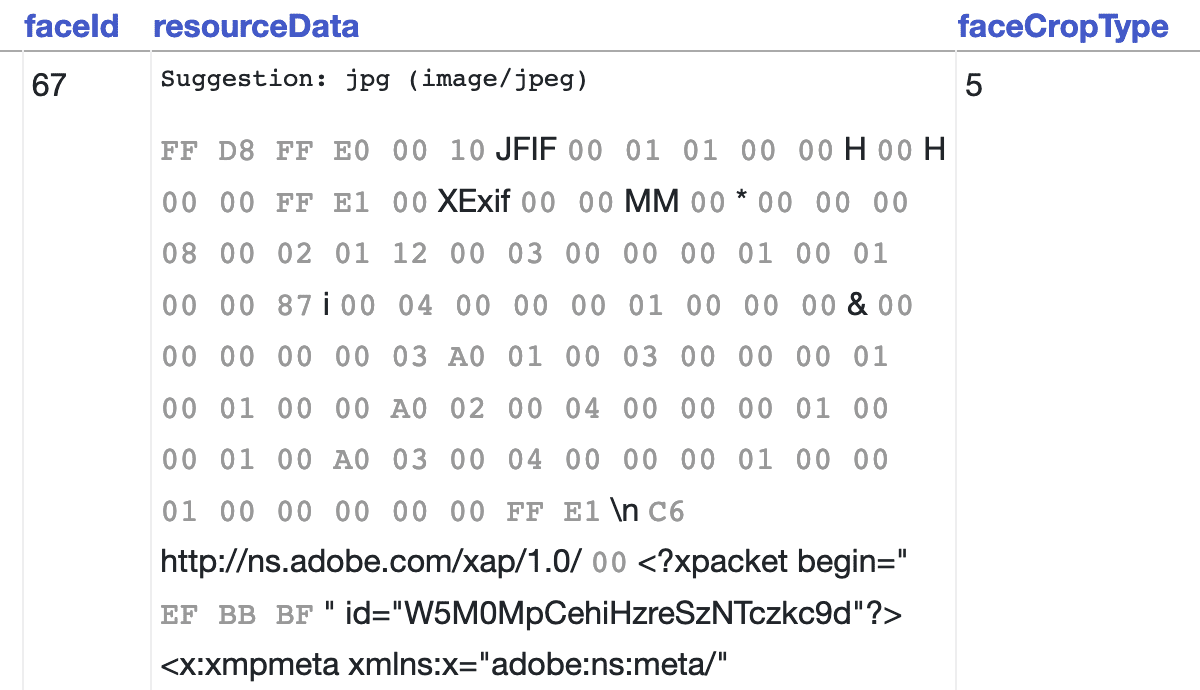
| 712581994 | https://github.com/simonw/datasette/issues/1034#issuecomment-712581994 | https://api.github.com/repos/simonw/datasette/issues/1034 | MDEyOklzc3VlQ29tbWVudDcxMjU4MTk5NA== | simonw 9599 | 2020-10-20T04:33:28Z | 2020-10-20T04:33:28Z | OWNER | The datasette-render-binary plugin does this, which I really like - but without the different coloured fonts I'm not sure how readable it would be as just plain text:
Really the goal here is to find the most human-friendly option, so that people looking at the output have a vague idea what's going on. That's why I'm not leaping at the chance to use base64. |
{
    "total_count": 0,
    "+1": 0,
    "-1": 0,
    "laugh": 0,
    "hooray": 0,
    "confused": 0,
    "heart": 0,
    "rocket": 0,
    "eyes": 0
} |
Better way of representing binary data in .csv output 725184645 | |
| 712580976 | https://github.com/simonw/datasette/issues/1034#issuecomment-712580976 | https://api.github.com/repos/simonw/datasette/issues/1034 | MDEyOklzc3VlQ29tbWVudDcxMjU4MDk3Ng== | simonw 9599 | 2020-10-20T04:29:23Z | 2020-10-20T04:29:23Z | OWNER | Most obvious option is base64. Any other potential solutions I'm missing? |
{
    "total_count": 0,
    "+1": 0,
    "-1": 0,
    "laugh": 0,
    "hooray": 0,
    "confused": 0,
    "heart": 0,
    "rocket": 0,
    "eyes": 0
} |
Better way of representing binary data in .csv output 725184645 |
Advanced export
JSON shape: default, array, newline-delimited, object
CREATE TABLE [issue_comments] (
   [html_url] TEXT,
   [issue_url] TEXT,
   [id] INTEGER PRIMARY KEY,
   [node_id] TEXT,
   [user] INTEGER REFERENCES [users]([id]),
   [created_at] TEXT,
   [updated_at] TEXT,
   [author_association] TEXT,
   [body] TEXT,
   [reactions] TEXT,
   [issue] INTEGER REFERENCES [issues]([id])
, [performed_via_github_app] TEXT);
CREATE INDEX [idx_issue_comments_issue]
                ON [issue_comments] ([issue]);
CREATE INDEX [idx_issue_comments_user]
                ON [issue_comments] ([user]);
user 1